No products in the basket.





Composite Decking Joist Spacing: 300mm, 400mm or 600mm?
Published · By Tough Decking Composite DeckingFor a new frame, set your joists at 300mm centres. That gives a composite deck a solid feel with no bounce, and it is the maximum we allow on our capped Elite range under the 15-year guarantee. If you are re-decking over an existing timber frame that sits at 400mm centres, you usually do not need to rip it out. Our Woodsman boards will go over 400mm centres as long as the frame is sound and you stiffen it first with noggins or sister joists. Whatever the spacing, the joists that matter most are the doubled ones under every board joint.
Joist spacing, or joist centres, is how far apart the joists sit under your deck boards, measured centre to centre. It trips people up because the right answer depends on whether you are building a new frame from scratch or laying composite over the timber frame that is already there. Here is how we handle both.
What joist spacing should you use for composite decking?
On a new subframe, work to 300mm centres. It suits both our ranges and gives the boards enough support that they will not flex between the joists. On the capped Elite range that 300mm is a firm maximum, written into the warranty, because those boards are a little thinner and need the extra support. Tighter is always better if you want to spend the timber, but for most fresh builds 300mm is the balance between a solid deck and a sensible amount of frame.
Re-decking over an existing frame at 400mm centres?
This is the question we get asked most, and it is where a lot of guides send people the wrong way. If you are pulling up old timber decking and laying composite on the frame underneath, that frame is very likely at 400mm centres, because that was fine for the old timber boards. The good news is you do not automatically need to tear it out and start again. Provided the frame is sound, level and properly fixed down, our Woodsman boards can go over 400mm centres once you stiffen it. The simplest way is to fit noggins, which are short lengths of timber fixed between the joists at intervals to cut the unsupported span and stop any flex. Sister joists, an extra joist fixed alongside each existing one, do the same job where you want belt and braces. Add those and a sound 400mm frame will carry Woodsman comfortably. The capped Elite range still needs 300mm, so for those boards you would fit extra joists between the existing ones to bring the centres in. Either way, you save ripping out a perfectly good subframe.
The joists that matter most
Wherever your centres land, the single most important joists are the doubled ones under the board ends. Every composite board has to have both ends fully supported and fixed down, so where two boards meet end to end you run two joists side by side, one under each board end. Stagger those joints across the deck rather than lining them all up, and you spread the load and keep the surface flat. Get the double joints right and you have dealt with the part that causes most of the movement people complain about.
When to go tighter than 300mm
There are jobs where we bring the centres in to around 250mm even on a new frame. Lay the boards on the diagonal and the span between joists gets longer at the angle, so you tighten the frame to keep the same firmness. The same goes for a deck that will take real weight, a hot tub, a heavy planter run, or a commercial area with constant footfall. Closer joists cost a little more in timber, but they are cheap insurance on a deck you want to last.
What about 600mm centres?
600mm is too wide for any deck boards, composite or timber. That figure comes from structural floor joists that span a whole room, which is a different job entirely. At 600mm a deck will bounce and the boards will sag in warm weather, and no amount of noggins really fixes a gap that big. If your existing frame is at 600mm, that is the one case where it is worth adding full joists to bring the centres down rather than trying to patch it.
Check the frame before you start
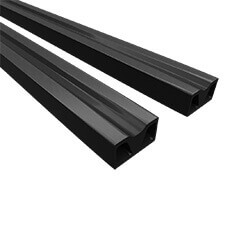
Whether you are reusing an old frame or building new, it has to be sound. Check for soft or rotten timber, make sure everything is level and fixed down, and build a slight fall into it so water runs off. If the existing frame is past its best, you can rebuild in treated timber or use our own composite decking joists, which are a good shout for balconies, flat roofs, or anywhere the frame sits low and damp is a worry. Our full composite decking installation guide runs through the do’s and don’ts.
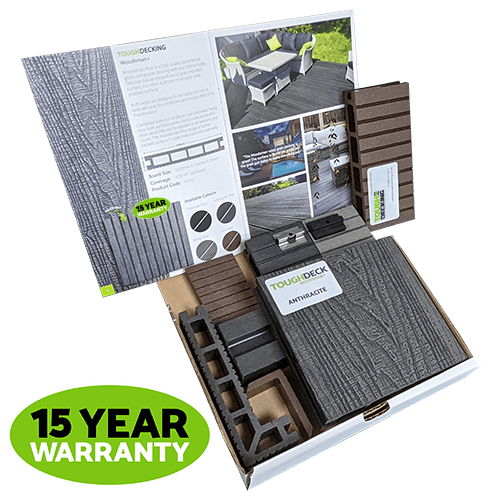
If you are planning a job and not sure whether your frame is up to it, give us a call with the details and we will talk it through. You can order a free sample pack to check the boards in your own garden first, or browse the full range on our composite decking boards page.